
⚠️ SECURITY ALERT · Updated 21 Oct 2026
Eight eMudhra certificate keys could be guessed in a second. One of them was literally the number 4.
The Indian certificate authority’s eight intermediate certificates chained to roots trusted by major browsers and operating systems. Chrome, Firefox, Apple and Microsoft have moved to block them, but many apps and servers still need updates, and Chrome’s removal of the parent root on 27 October may break some legitimate websites.
4
smallest private key
8
compromised intermediates
<3 hrs
for Firefox to block
27 Oct
Chrome root removal
🔔 UPDATE · 21 OCTOBER 2026
Google says Chrome will remove the emSign ECC Root CA – G3 from the Chrome Root Store, with the change expected to reach all devices relying on it on Tuesday, 27 October 2026 (PDT), and sooner on Chrome Canary and Beta. This is separate from blocking the eight compromised intermediates. Legitimate websites whose certificates chain to this root will stop working in Chrome unless their owners install a certificate from another trusted hierarchy before then.
⚡ QUICK READ
- 🔑 What: Private keys for 8 intermediate certificates from Indian CA eMudhra (emSign brand) were tiny numbers between 4 and 237, so anyone could recover them.
- 🎯 Risk: With those keys, an attacker who can also intercept your traffic could fake HTTPS for any website to software that still trusts them.
- 🛡️ Browsers: Firefox, Chrome, Apple and Microsoft have deployed blocks. Most people on supported, up-to-date browsers should be protected, but test each browser you use.
- 🧩 Possibly exposed: Apps with their own certificate lists, such as some Python, Node.js and Go programs, Linux servers, Docker images and IoT devices. It depends on the exact runtime, package version and trust store.
- 📅 Coming next: Chrome drops the parent emSign root on 27 October. Sites still using it will show certificate errors in Chrome.
- ✅ Do this now: Update your browser and OS, then run the free check at emudhra.we-have-a-problem.com. Steps are below.
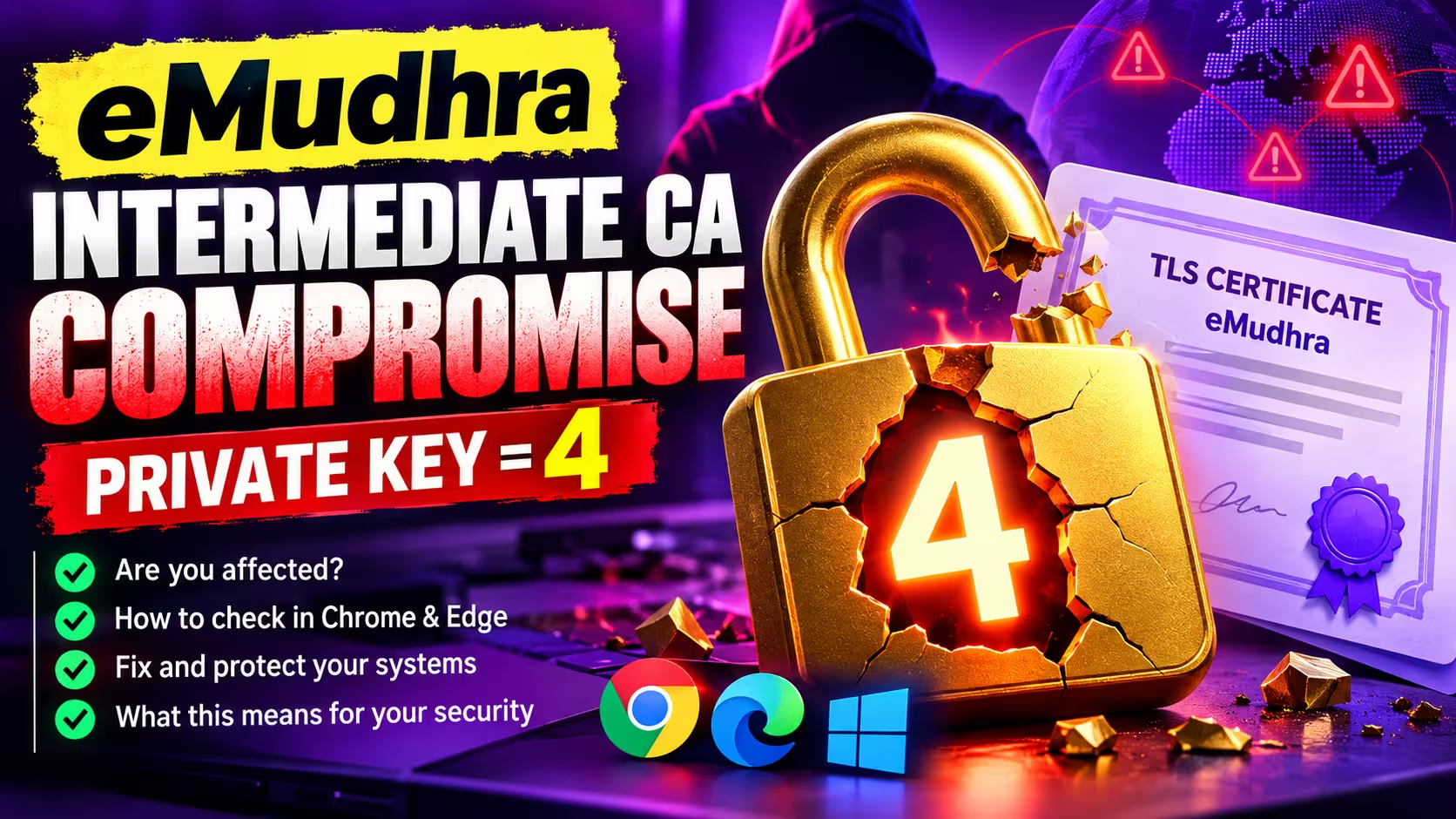
What happened with the eMudhra certificates?
On Saturday, 17 October 2026, a security researcher identified only as Wayne reported to the browser root programs that he held the private keys of eight intermediate certificates belonging to eMudhra Limited, a Bengaluru-based, NSE/BSE-listed certificate authority that sells TLS certificates under the emSign brand.
To prove it, he signed the message “We have a problem here – Wayne” with each of the eight keys. That is cryptographic proof: only the holder of a private key can produce a valid signature that matches the certificate’s public key. Mozilla engineer Dennis Jackson later published the signatures, the certificates and a public test page at emudhra.we-have-a-problem.com.
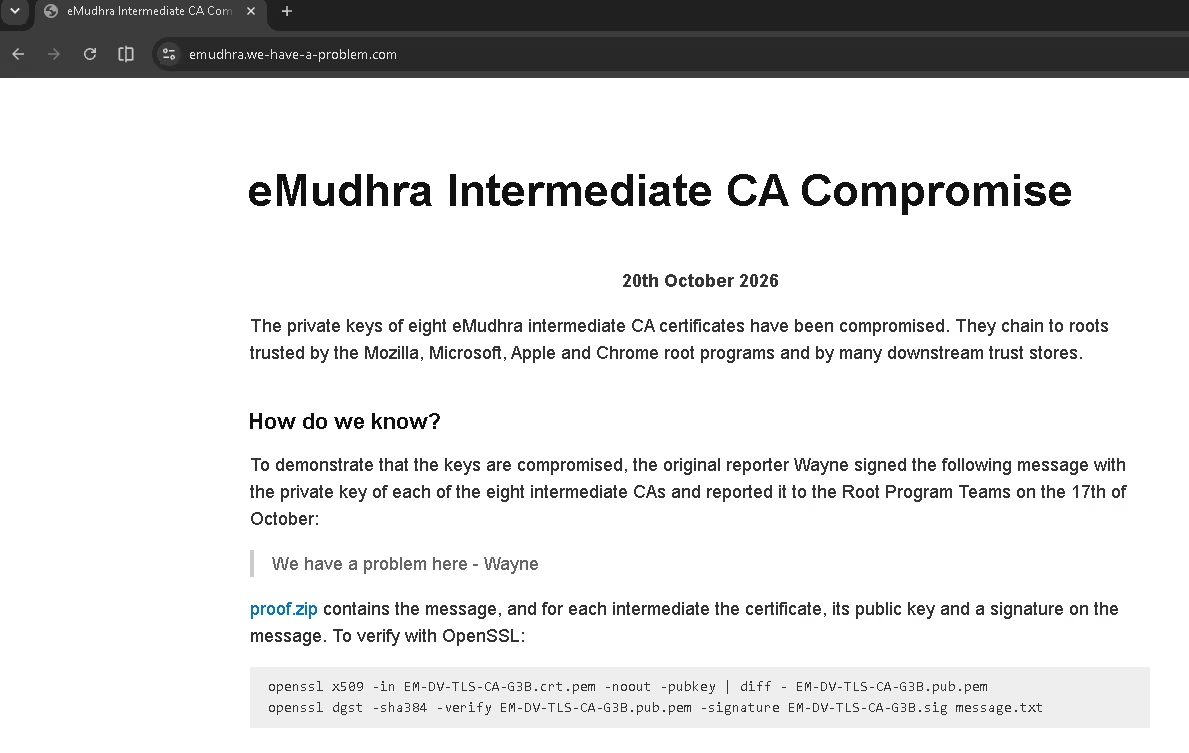
The keys were not stolen in a hack. According to Mozilla’s incident report, quoted by BleepingComputer, they were generated in April 2025 with values smaller than 256. eMudhra told Mozilla that a script error during its key generation ceremony created a second set of weak keys, which were picked for signing by mistake because their labels looked like those of the properly generated keys. The weakness existed for about 18 months before anyone noticed.
🏢 What eMudhra says
In its public statement, eMudhra says the incident is limited to these intermediates and does not affect its root CA private keys or other intermediates. It also says one of the eight was deployed in production, but that none of them, including that one, issued any end-entity certificates such as website certificates. That is the company’s own account, which it says matches public Certificate Transparency records.
Timeline (UTC, with India time in brackets)
April 2025 ORIGIN
eMudhra generates the eight intermediate certificates with faulty, tiny keys. Some are sent to Sectigo for cross-signing.
17 Oct 2026, 18:05 (23:35 IST) REPORT BLOCK
Chrome Root Program receives the report. A CRLSet update covering the six TLS intermediates follows the same day.
17 Oct 2026, 20:06 (18 Oct, 01:36 IST) REPORT
Mozilla receives the report.
17 Oct 2026, 22:59 (18 Oct, 04:29 IST) BLOCK
Firefox protection reaches all standard installs through OneCRL, under 3 hours after the report.
18 Oct 2026 REVOCATION
eMudhra marks the eight certificates as revoked. Revocation only protects software that actually checks it.
19 Oct 2026 REVOCATION BLOCK
Sectigo revokes its cross-signs. Apple adds protections. Linux distros and language maintainers are privately notified.
20 Oct 2026 BLOCK RELEASES
Public disclosure. Microsoft platforms blocked. Firefox 158.0.1 and ESR updates, NSS 3.131.1 (drops the root), Go 1.27.3 and 1.26.10, Python certifi and others released.
27 Oct 2026 (PDT) ROOT REMOVAL
Chrome’s removal of emSign ECC Root CA – G3 expected to reach all devices using the Chrome Root Store.
Why a private key of “4” is so shocking
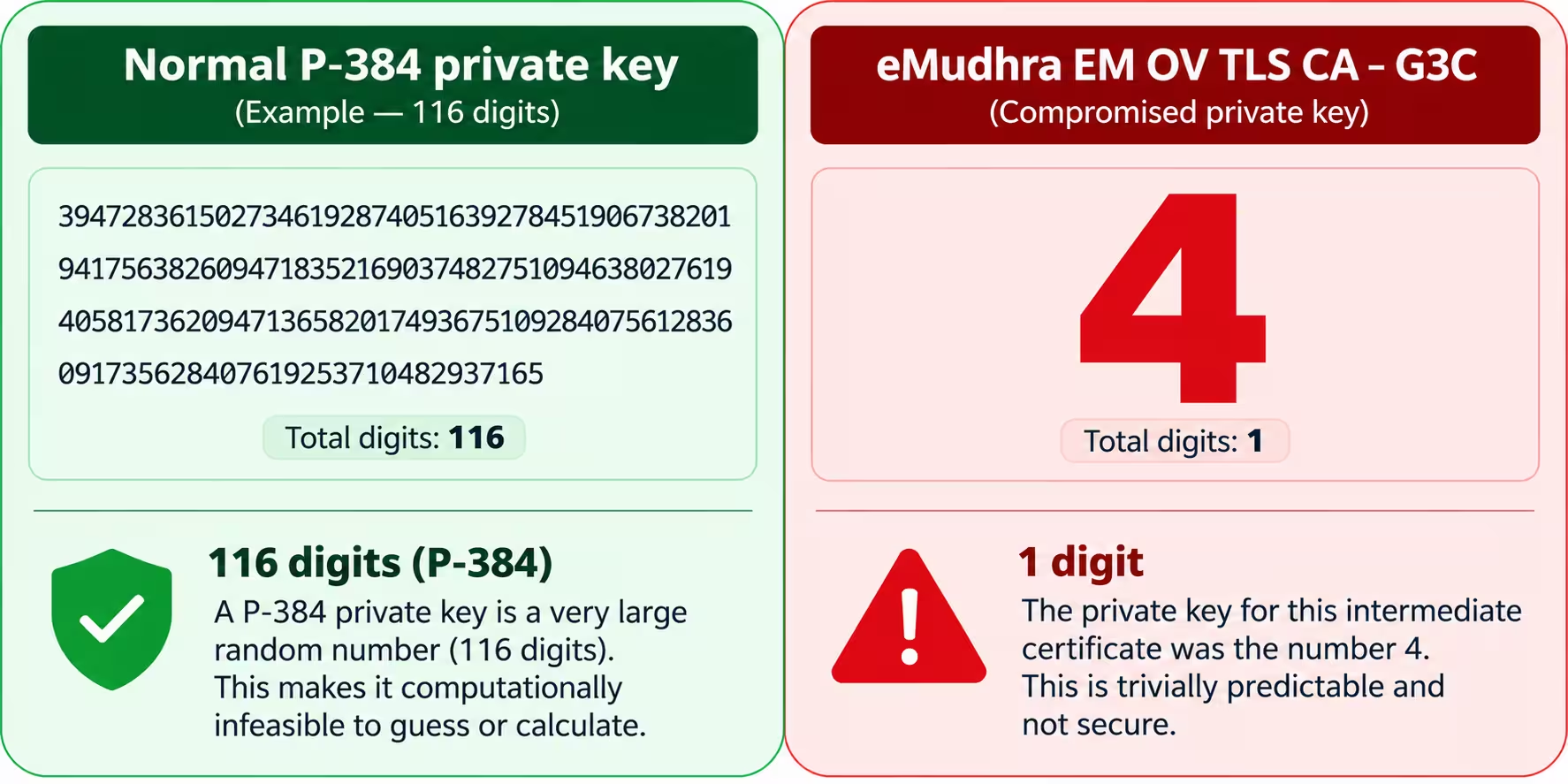
These certificates use P-384, a strong elliptic-curve standard. A P-384 private key is supposed to be a random number about 116 digits long. Guessing one would take longer than the age of the universe. That randomness is the whole security model.
eMudhra’s eight keys were instead these numbers, between 3 and 8 bits in size:
Since every one was below 256, an attacker only had to try the numbers 1 to 256 against each certificate’s public key. A laptop does that instantly. Researcher Flüpke published the key for EM OV TLS CA – G3C, which is simply 4, and BleepingComputer independently confirmed it matches the revoked certificate.
💡 IN PLAIN WORDS
The encryption math was never broken. The lock was strong, but the key was left under the doormat with a label on it.
Which certificates were affected?
Six of the eight intermediates could issue website (TLS) certificates and two were for code signing. The TLS ones sit under emSign Root TLS CA – G3, which chains to emSign ECC Root CA – G3. Some were also cross-signed by Sectigo through its AAA Certificate Services root, which is why that root shows up in Linux fixes too.
| Intermediate CA | Type | Operating entity |
|---|---|---|
| EM DV TLS CA – G3B | TLS, domain validated | eMudhra BV (Netherlands) |
| EM DV TLS CA – G3C | TLS, domain validated | eMudhra Inc (USA) |
| EM OV TLS CA – G3B | TLS, organisation validated | eMudhra BV |
| EM OV TLS CA – G3C | TLS, organisation validated KEY = 4 | eMudhra Inc |
| EM EV TLS CA – G3B | TLS, extended validation | eMudhra BV |
| EM EV TLS CA – G3C | TLS, extended validation | eMudhra Inc |
| 2 code-signing intermediates (G3B / G3C) | Code signing | eMudhra |
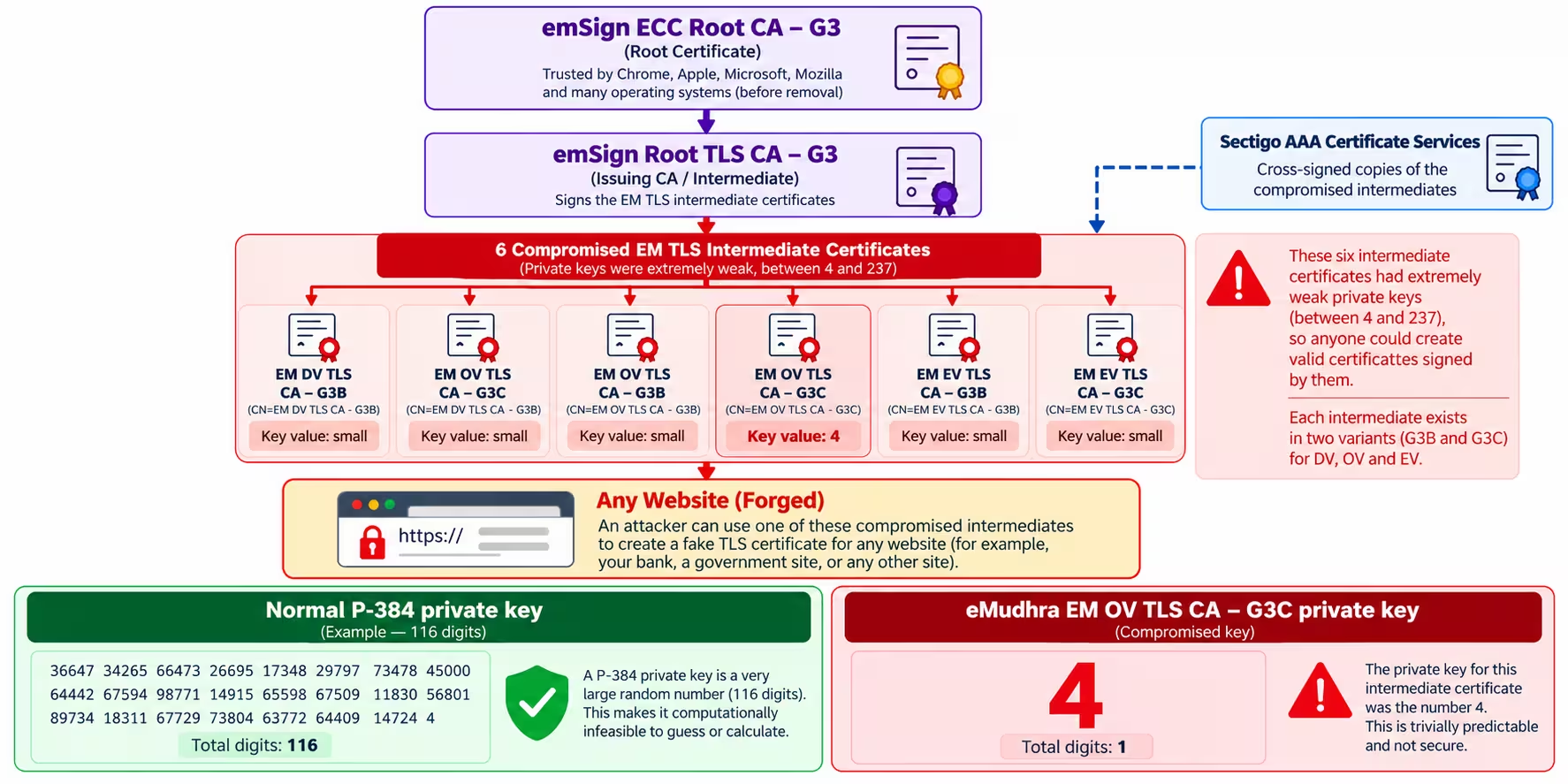
eMudhra has revoked all eight and stopped issuing from every intermediate under its G3 root.
How Firefox, Chrome, Apple and Microsoft responded
🦊 Firefox
✓ BLOCKED 17 OCT
Blocked through OneCRL, Mozilla’s central revocation list, with no update or restart needed. Firefox 158.0.1 (desktop and Android), ESR 115.43.1 and ESR 153.5.1 followed on 20 October for users whose settings blocked OneCRL. Mozilla also removed the emSign ECC Root CA – G3 from NSS 3.131.1 to protect other apps that copy its trust store.
🌐 Chrome
✓ BLOCKED 17 OCT
Blocked via a CRLSet update. Because Google blocked the public keys themselves, the Sectigo cross-signs sharing those keys were covered too. The two code-signing intermediates needed no block, since Chrome will not build a website chain through them. Google is also removing the emSign ECC Root CA – G3 from the Chrome Root Store from 27 October.
🍎 Apple
✓ BLOCKED 19 OCT
Protected Apple devices from 19 October.
🪟 Microsoft
✓ BLOCKED 20 OCT
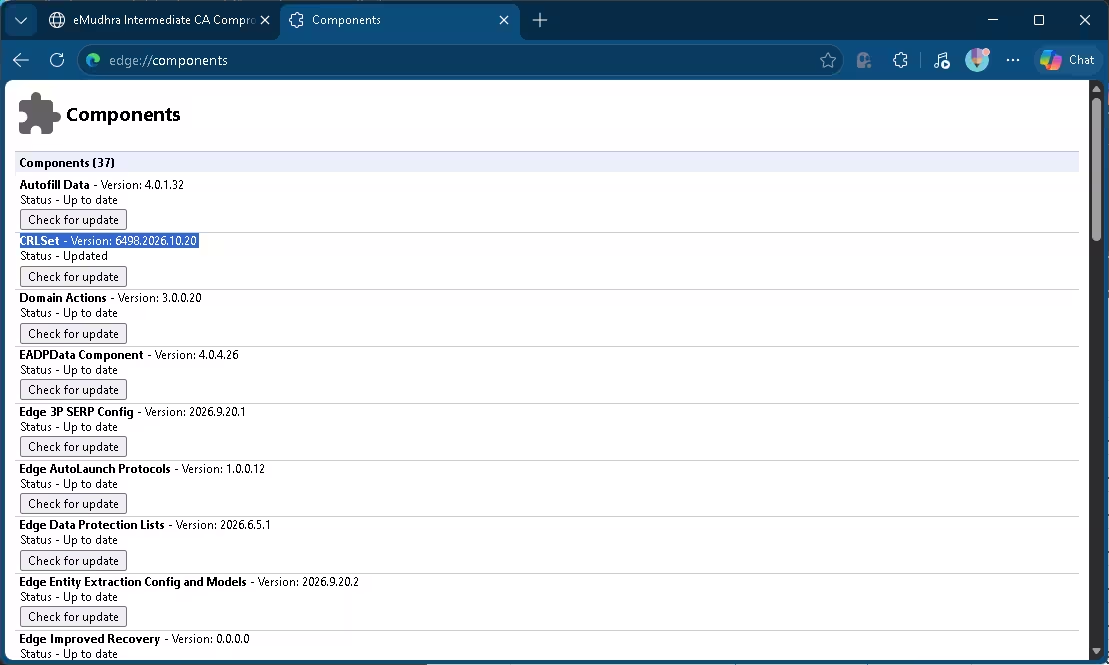
The incident site lists Microsoft platforms as blocked from 20 October. Microsoft had not published its own notice when we checked on 21 October, and Ars Technica reported Edge on Windows 10 was still connecting to the test hosts when its story went live. That looks like a rollout delay: on our Windows test PC on 21 October, Edge rejected all the test hosts, and Windows’ built-in curl.exe refused the connection with “the certificate is revoked”. Edge users should still run the test themselves (steps below).
Cloudflare also patched its own services and shipped updates for the 1.1.1.1 / WARP app and cloudflared.
Are you actually at risk?
For most people using a supported, up-to-date browser, the immediate risk has been sharply reduced. There are two reasons.
1️⃣ An attack needs a man-in-the-middle position
A forged certificate is only useful if the attacker can also intercept your traffic, for example on a rogue Wi-Fi hotspot, a compromised router or at the network level. Nobody can steal your data just because these keys exist.
2️⃣ Browsers enforce Certificate Transparency
Chrome, Firefox, Safari and Edge normally only accept website certificates that have been publicly logged. Google says no TLS certificates chaining to these six intermediates appeared in CT logs before its block, so no forged certificate could have been trusted by default in CT-enforcing browsers. That is strong evidence against misuse aimed at browsers, but it is not proof that no attack happened anywhere, for example against software or configurations that don’t enforce CT.
⚠️ THE REAL DANGER IS OUTSIDE THE BROWSER
Many programs do not check CT or revocation lists. They carry a fixed list of trusted roots and may keep trusting these intermediates until that list is updated. Depending on the version and setup, this can include Python apps using an older certifi, Node.js and Go services, curl on macOS, API clients, Docker containers, routers, smart TVs and other IoT gear. The incident site says nobody knows whether attackers used the flaw against such clients in the past 18 months.
Because eMudhra is Indian, posts on X have claimed that government websites will become hard to access in India. The picture is more nuanced, and it has two separate parts.
✅ Part 1: Blocking the eight intermediates
This should not break normal websites. eMudhra says none of the eight issued website certificates, and Google found none in CT logs. There was nothing for real sites to lose.
⚠️ Part 2: Removing the parent root
This one can affect legitimate websites. Mozilla has already dropped the emSign ECC Root CA – G3 from NSS, and Chrome follows on 27 October. Any site whose certificate came from a different, uncompromised intermediate under that same root will start showing certificate errors in Chrome and in updated non-browser software unless its owner switches to another certificate provider. eMudhra’s preliminary estimate is about 30,000 certificates in the wider G3 hierarchy needing migration, according to Implicator.ai. Which specific Indian websites, government or private, use this root has not been published.
- Your DSC is a different system. The Digital Signature Certificates many Indians use for Income Tax, MCA and GST filing are issued by eMudhra under India’s Controller of Certifying Authorities (Root Certifying Authority of India). That hierarchy is separate from the emSign WebPKI roots involved here, and no impact on DSCs has been reported in the sources we reviewed.
- “60 million certificates” is eMudhra’s total of all digital certificates issued, mostly DSCs. The compromise covers eight intermediate certificates, and the root removal affects the G3 hierarchy, not every certificate eMudhra ever issued.
The bigger questions for India are about trust. An Indian licensed Certifying Authority shipped keys a schoolchild could guess, and it went unnoticed for 18 months. Google has said it is still reviewing eMudhra’s remaining roots, so Indian organisations buying emSign TLS certificates should watch for further decisions.
If you run a website with an emSign certificate
🛠️ ACTION FOR SITE OWNERS · BEFORE 27 OCTOBER
Click the padlock in your browser, view the certificate and open the certification path. If it ends at emSign ECC Root CA – G3, Google advises getting and installing a new TLS certificate from another hierarchy in the Chrome Root Store before 27 October. Free options such as Let’s Encrypt work for most sites. eMudhra says it is working with affected customers on migration.
How to check and protect yourself (step by step)
Update everything
Update your browser, Windows, macOS, iOS and Android. If you use Cloudflare’s 1.1.1.1 / WARP app, update it to v6.38.10 on Android, v6.31.7 on iOS or 2026.8.2115.0 on desktop.
Run the free browser test
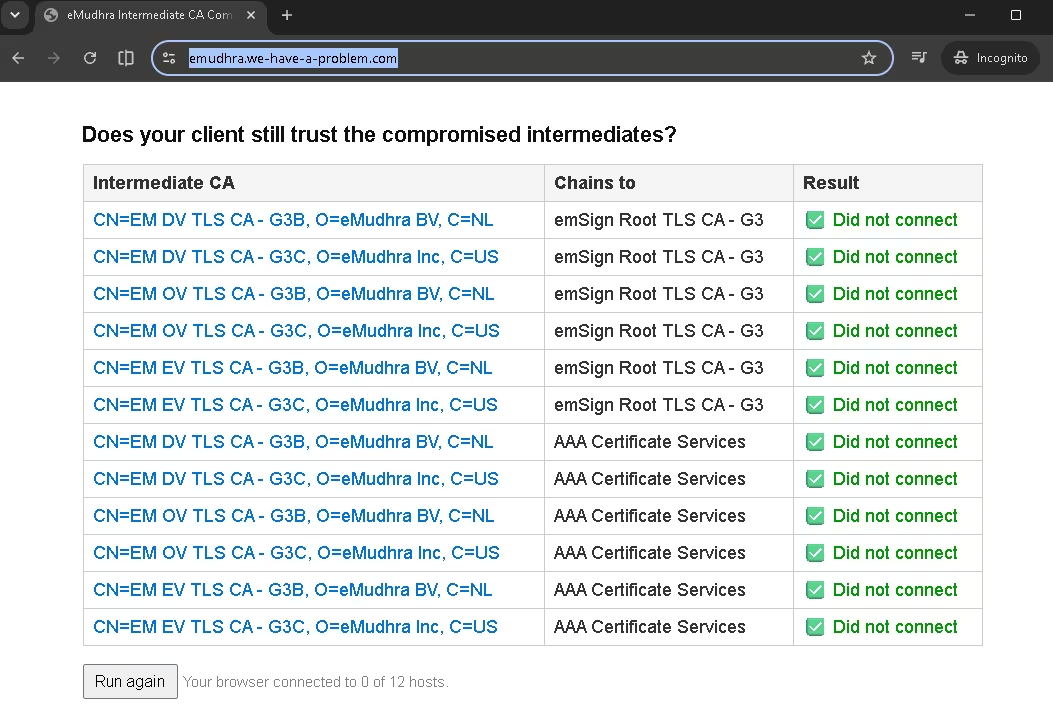
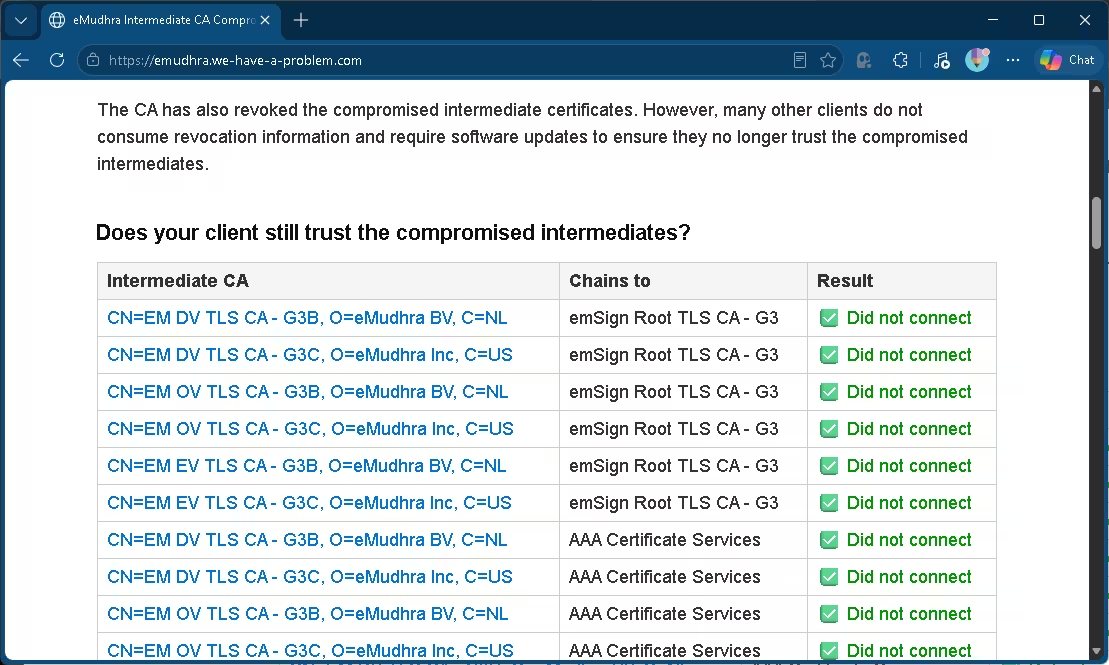
Open emudhra.we-have-a-problem.com/#check in each browser you use. Every row should show ✅ Did not connect. If any row connects, that browser still trusts a compromised certificate.
Chrome or Edge failing? Force a CRLSet update
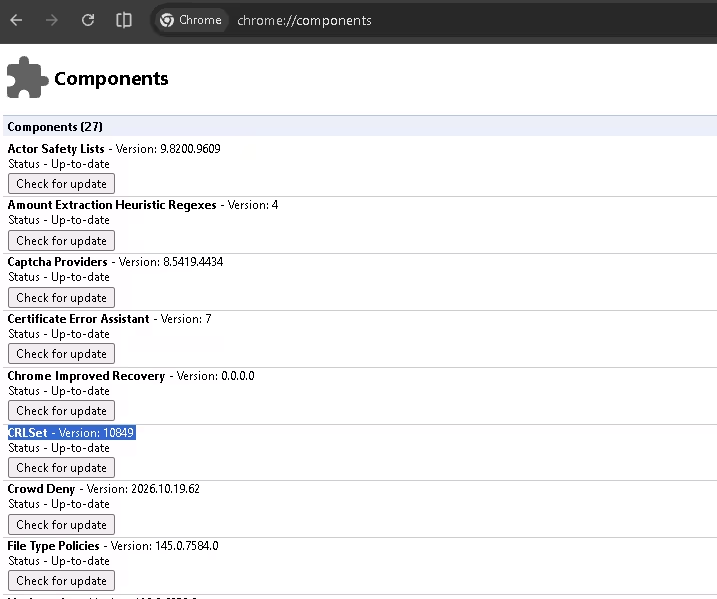
Type chrome://components (or edge://components in Edge) in the address bar, find CRLSet and click Check for update. Restart the browser and run the test again. For reference, when both browsers passed the test on our Windows PC on 21 October, Chrome showed CRLSet version 10849 and Edge showed 6498.2026.10.20. Newer numbers will follow, so go by the test result rather than a specific version.
Firefox users: check your version
Open Menu → Help → About Firefox to get 158.0.1 or later.
Be careful on public Wi-Fi
Take care with non-browser apps until your devices are updated, especially older apps and smart devices that rarely get patches.
Don’t click through certificate errors
After 27 October, a legitimate site still on the removed root may show a warning in Chrome. That is the site’s problem to fix, not your PC’s. Don’t bypass the warning to enter passwords or payment details.
A passing browser test only proves that one browser is safe. Other apps on the same PC may use their own certificate lists.
For developers and sysadmins
Test any command-line client with:
curl https://dv-g3b-aaa-emudhra.we-have-a-problem.com/
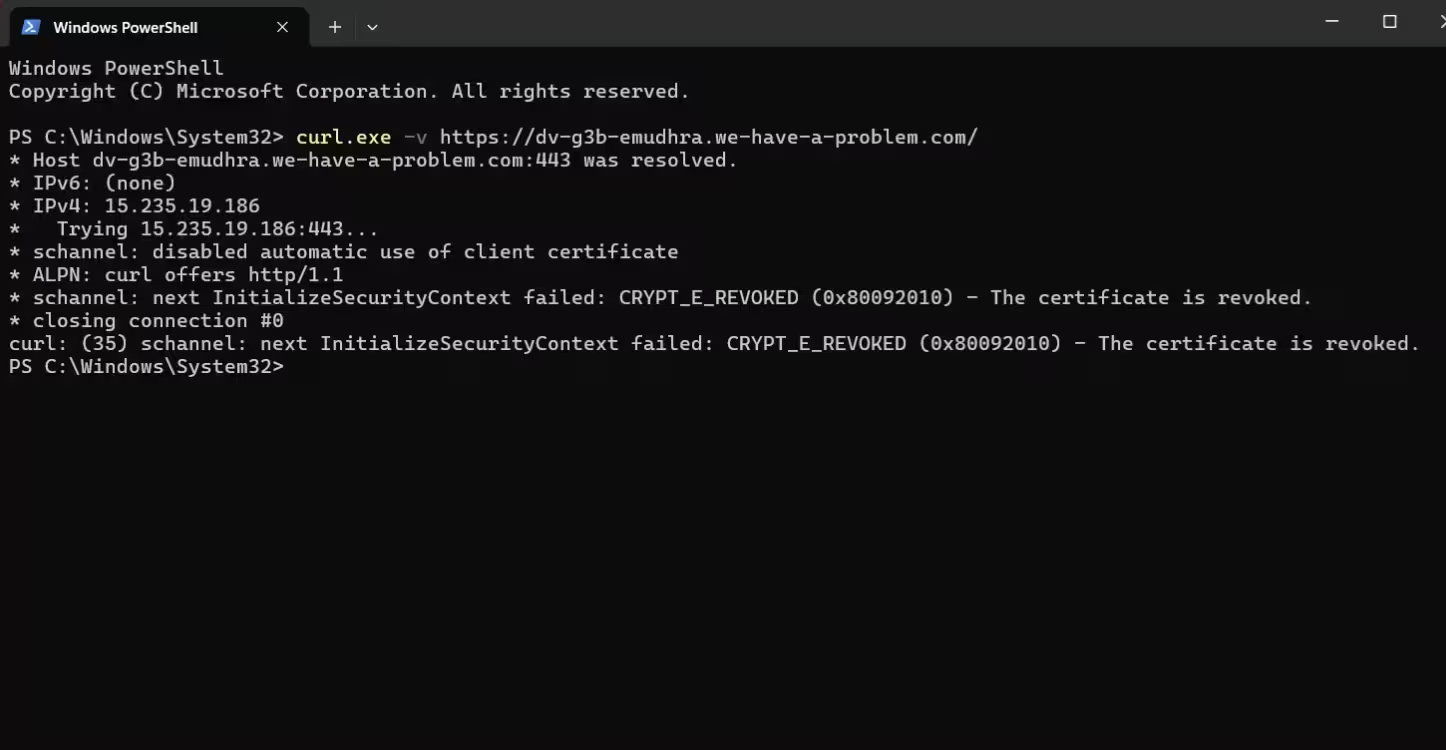
A certificate error is the good result, but it only covers the client you tested. An app that uses a different library or bundled trust store needs its own check. Key patched versions, as listed on the incident site and checked on 21 October 2026, are below. Confirm the branch that applies to you in each project’s release notes.
| Software | Patched version |
|---|---|
| Go | 1.27.3, 1.26.10 |
| Python certifi | 2026.10.19 |
| pip / uv | 26.2.2 / 0.13.4 |
| NSS | 3.131.1 |
| curl CA bundle | 2026-10-20 |
| Electron | 44.9.1, 43.8.1, 42.11.16 |
| Rust webpki-roots / rustls-webpki | 1.0.10 / 0.103.16 |
| Ubuntu, Debian, Arch, Alpine, Fedora, Gentoo ca-certificates | Updates released (version varies by release) |
| Node.js, Bun, FreeBSD | PENDING at time of writing |
| Cloudflare Tunnel (cloudflared) | 2026.10.2 |
Updating an SDK is not enough if it relies on the OS or runtime trust store underneath, so check the whole dependency tree, rebuild container images and restart services. Once updated bundles drop the emSign root, expect errors from legitimate servers still on that chain.
🚫 NEVER TURN OFF VERIFICATION
Cloudflare’s advice is worth repeating: do not fix certificate errors by turning off verification. The incident site also has manual distrust commands for Linux, macOS curl and BSD, but those remove an entire Sectigo root and are meant for experienced admins only.
Why experts call it bigger than Heartbleed
“
A massive cleanup job, bigger than Heartbleed.
Filippo Valsorda, Go cryptography maintainer, speaking to Ars Technica
Browsers fixed it with a remote switch in hours. Everything else, from forgotten Linux machines to embedded devices that bundle their own root lists, needs a software update someone has to ship and install.
The incident also exposes a structural weakness. Any one of the dozens of trusted CAs can vouch for any website, so a single careless CA puts everyone at risk. Fast revocation tools like OneCRL and CRLSets protected browser users here, and Cloudflare is now pushing for the same quick-update ability in operating system trust stores.
📊 TECHNO360 VERDICT
This is one of the most embarrassing certificate authority failures on record, but not a reason to panic. For most users with supported, up-to-date browsers, browser-level blocking has sharply reduced the immediate risk. Run the test in every browser you use and confirm it shows Did not connect. Remember that the test does not check your other apps.
The work that remains is for developers, IT teams, device makers and website owners still on the emSign G3 root. If you run servers, scripts or self-hosted tools, update your CA bundles today. If your site uses that root, replace the certificate before 27 October.
Frequently asked questions
What is eMudhra?
eMudhra is a Bengaluru-based, publicly listed digital trust company. It is a licensed Certifying Authority in India for Digital Signature Certificates and also runs the emSign certificate authority, whose roots are included in major browser and operating system trust stores.
Was eMudhra hacked?
No break-in has been reported. eMudhra attributed the problem to a script error during an April 2025 key generation ceremony that produced weak keys, which were then used by mistake. Because the keys were so small, anyone could calculate them from the public certificates.
Is my Chrome or Firefox browser safe?
Most users of supported, up-to-date Chrome and Firefox should be protected, as both have blocked the certificates since 17 October. Confirm by visiting emudhra.we-have-a-problem.com/#check in each browser and making sure every row says Did not connect. The test does not check other apps on your device.
How do I update CRLSet in Chrome or Edge?
Go to chrome://components or edge://components, find CRLSet, click Check for update, then restart the browser.
Will Indian government websites stop working?
Blocking the eight compromised intermediates should not affect normal websites, because none issued website certificates. However, Chrome is removing the parent emSign ECC Root CA – G3 from 27 October 2026, and Mozilla has already done so. Any website, government or private, whose certificate chains to that root may show errors until its owner moves to another certificate provider. Which sites are affected has not been published.
Does this affect my eMudhra DSC for Income Tax or GST?
No impact on those Digital Signature Certificates has been reported in the sources we reviewed. The affected certificates belong to the emSign public TLS hierarchy, which is separate from India’s Root Certifying Authority hierarchy used for DSCs. That is reassuring, but it is not a guarantee covering every eMudhra product or service.
My site uses an emSign certificate. What should I do?
Check whether your certificate chain ends at emSign ECC Root CA – G3. If it does, Google advises installing a new TLS certificate from another hierarchy in the Chrome Root Store before 27 October 2026 to avoid errors in Chrome.
Has anyone used these keys to attack people?
No attacks have been reported. Cloudflare found no active exploitation on its network, and CT logs show no certificates from the affected intermediates. However, the incident site notes nobody can rule out attacks on non-browser clients during the 18 months the keys were weak.
Sources
- Google: Protecting Chrome and Android users from compromised eMudhra intermediate CA certificates
- Mozilla Security Blog: Protecting Firefox users
- eMudhra: Statement on recent certificate security incident
- eMudhra Intermediate CA Compromise incident and test site
- Mozilla dev-security-policy announcement
- Cloudflare: 8 eMudhra certificates are compromised
- Ars Technica: The Internet goes on high alert
- BleepingComputer: Mozilla, Google, Apple block compromised eMudhra CA certificates
- Implicator.ai: eMudhra estimates 30,000 certificates need migration
Browser and package status last checked: 21 October 2026. Browser tests run by Techno360 on Windows in Chrome and Edge, 21 October 2026.
More security coverage: Techno360 Security →
Discover more from Techno360
Subscribe to get the latest posts sent to your email.

You must be logged in to post a comment.